---
title: W-4 & Tax Withholding FAQs
description: Find answers to common questions about the W-4 form and tax withholdings in iSolved. Learn when to update your withholdings and how your elections impact your paycheck.
---
[Skip to content](https://resources.candoorhcm.com/help-center/w-4-tax-withholding-faqs#main-content)
English
Show submenu for translations
[More support](https://resources.candoorhcm.com/help-center/kb-tickets/new?hsLang=en)
[](https://resources.candoorhcm.com/help-center?hsLang=en)
- [Blog](https://blog.candoorhcm.com/)
- [Home](https://candoorhcm.com/)
- Solutions
Show submenu for Solutions
- [Payroll](https://candoorhcm.com/payroll/)
- [Tax Pay](https://candoorhcm.com/tax-pay/)
- [Time and Attendance](https://candoorhcm.com/time-attendance/)
- [Attract and Hire](https://candoorhcm.com/attract-hire/)
- [Employee Onboarding](https://candoorhcm.com/employee-onboarding/)
- [Employee Offboarding](https://candoorhcm.com/employee-offboarding/)
- [FAQs](https://candoorhcm.com/faqs/)
- [Forms and Tools](https://candoorhcm.com/forms-tools/)
Open main navigation
Close main navigation
- [Blog](https://blog.candoorhcm.com/)
- [Home](https://candoorhcm.com/)
- Solutions
Show submenu for Solutions
- [Payroll](https://candoorhcm.com/payroll/)
- [Tax Pay](https://candoorhcm.com/tax-pay/)
- [Time and Attendance](https://candoorhcm.com/time-attendance/)
- [Attract and Hire](https://candoorhcm.com/attract-hire/)
- [Employee Onboarding](https://candoorhcm.com/employee-onboarding/)
- [Employee Offboarding](https://candoorhcm.com/employee-offboarding/)
- [FAQs](https://candoorhcm.com/faqs/)
- [Forms and Tools](https://candoorhcm.com/forms-tools/)
- English
Show submenu for translations
- [More support](https://resources.candoorhcm.com/help-center/kb-tickets/new)
- [Contact us](https://candoorhcm.com/contact-candoor-payroll-hcm-services-lafayette-in/)
[Contact us](https://candoorhcm.com/contact-candoor-payroll-hcm-services-lafayette-in/)
How can we help you?
- There are no suggestions because the search field is empty.
1. [Candoor Payroll](https://resources.candoorhcm.com/help-center?hsLang=en)
2. [Employee](https://resources.candoorhcm.com/help-center/employee?hsLang=en)
3. [Employee Self Service](https://resources.candoorhcm.com/help-center/employee?hsLang=en#employee-self-service)
June 4, 2026
# W-4 & Tax Withholding FAQs
## This article answers common questions about the W-4 form and tax withholdings in isolved — including what the form is, when to update it, and how your withholding elections affect your paycheck.
[View the full FAQ here.](https://scribehow.com/page/W4_and_Tax_Withholding_FAQs__JBAjUmAPQheFSnV-tezxIQ)
**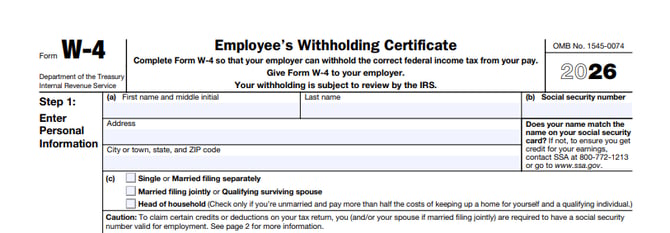**
**What is my filing status and why does it matter?**
Your **filing status** sets the foundation for how your taxes are calculated. It determines your standard deduction and how much federal tax is withheld from your paycheck.
**Common filing statuses include:**
- **Single** – You file individually and receive the **standard baseline deduction**.
- **Married (Filing Jointly)** – You file together with your spouse. The IRS typically allows a **higher standard deduction** since household expenses are shared.
- **Head of Household** – You are unmarried and provide more than half of the financial support for a child or dependent. This status offers a **larger deduction** to help offset caregiving costs.
**What is a dependent?**
A **dependent** is generally:
- A qualifying child under age 17, or
- A qualifying relative who relies on you for primary financial support (such as housing and food).
---
**How do dependents affect my paycheck?**
Claiming dependents works like a **tax credit** that reduces the amount of federal tax taken out of your paycheck.
- Each qualifying child provides a **$2,200 annual tax credit**.
- When you claim a dependent on your W‑4, payroll spreads that credit across the year to reduce withholding.
**Example:**
If you claim **one dependent ($2,200)**:
- $2,200 ÷ 12 months = **about $183.33 per month**
- This results in **less tax being withheld** from each paycheck, which increases take‑home pay but may result in a smaller tax refund.
**What are deductions in Step 4b?**
This is for people who expect to have **large deductions** beyond the standard deduction, such as:
- Significant mortgage interest
- Large charitable donations
If this applies to you, entering deductions tells payroll to withhold **less tax**, since your taxable income will likely be lower when you file.
---
**What is extra withholding (Step 4c)?**
This is the **“no surprises” option**.
You can request a specific dollar amount to be withheld from each paycheck if you want to:
- Avoid owing money at tax time
- Create a safety buffer throughout the year
Many employees use this if they’ve owed taxes in the past or want peace of mind.
---
**Can payroll tell me what to put on my W‑4?**
Payroll teams **cannot give tax advice** or tell you what to claim. However:
- A **tax preparer** can help determine the best setup for your situation.
- The IRS offers a free **Withholding Estimator** online to help you decide.
- [IRS Tax Withholding Estimator](https://apps.irs.gov/app/tax-withholding-estimator)
---
**What happens if my situation changes?**
If you get married, have a child, take on another job, or want to adjust withholding, you can submit an **updated W‑4 at any time in the Employee Workspace Portal**. Changes will apply going forward.
---
**Why did my taxes change this paycheck?**
It’s frustrating to see a smaller paycheck when you haven't changed your withholdings. Usually, this is caused by one of three "automatic" triggers:
**1. The "Extra Pay" Trap**
If you worked overtime, earned a bonus, or got a small raise, the payroll system might have viewed you as being in a higher "bucket" for that specific check.
- **How it works:** Payroll "snapshots" your current check and imagines you’ll make that exact amount every time. If one check is higher, it assumes your annual income has jumped and holds back a slightly higher percentage to cover it. Think of tax brackets like buckets. The first dollar you earn goes into the 10% bucket. Once that bucket is full, the next dollar goes into the 12% bucket, and so on.
**2. The IRS "New Year" Reset**
Every January, the IRS adjusts tax rules for inflation.
- **The Result:** Even if your salary is identical to December’s, your January taxes might be different because the IRS changed the "Standard Deduction" or the bracket limits for the new year.
**3. Changes to your Benefits**
Did you recently change your 401(k) contribution, health insurance plan, or HSA?
- **The Math:** Most benefits are "pre-tax."
- If you **increase** your 401(k) contribution, you have **less** taxable income. The system will automatically lower your tax withholding to match.
**Why was there no Federal Withholding on my check(s)?**
This is not an automatic red flag and can be caused by a few very normal situations.
**1. Your W-4 elections**
If you claimed:
- “Exempt” from federal withholding, or
- A high number of dependents/credits
…payroll software may calculate that you owe $0 in federal tax for that paycheck.
**2. Your earnings for that pay period were low**
Federal withholding is based on *that specific check*, not your annual income in isolation. If your wages for the period were under a certain threshold (especially after pre-tax deductions), withholding can drop to zero.
**3. Filing status + pay frequency combo
The IRS tables factor in:**
- Filing status (Single, Married, etc.)
- Pay frequency (weekly, biweekly, etc.)
Certain combinations—especially “Married” with standard deductions—can result in little or no withholding unless income is higher.
**IRS Withholding Tables:**
Unlike many other mandatory tax withholdings, Federal Withholding is not typically a "fixed percentage". You can see the IRS Withholding tables using \[[this link](https://www.irs.gov/pub/irs-pdf/p15t.pdf)\]. Scroll down to the pages that are for your pay frequency, weekly, biweekly, etc.
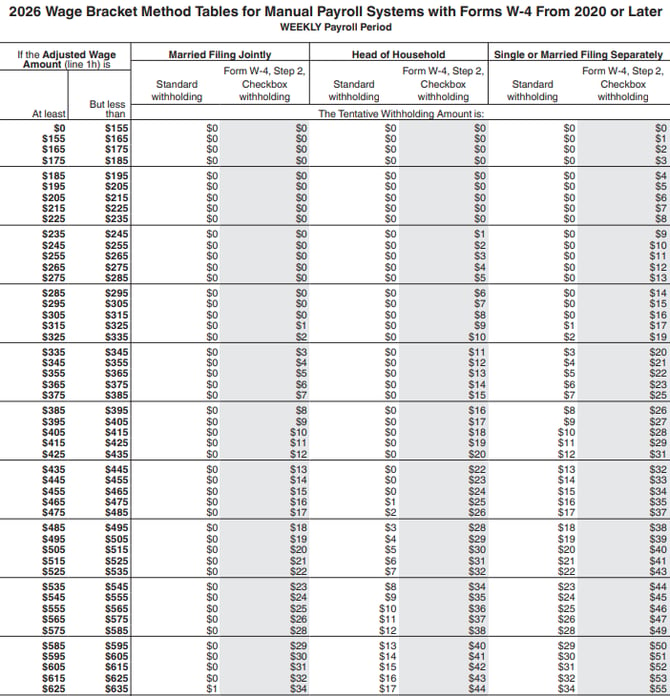
In the image above, you can see for a Single person being paid weekly, they have to earn a minimum of $625 in order to have ANY Federal Tax calculated or withheld.
***\*Candoor Payroll & HCM provides the information in this article for general guidance only, and does not constitute the provision of legal advice, tax advice, accounting services, investment advice, or professional consulting of any kind. The information provided herein should not be used as a substitute for consultation with professional tax, accounting, legal, or other competent advisers. Before making any decision or taking any action, you should consult a professional adviser who has been provided with all pertinent facts relevant to your particular situation. The information is provided "as is," with no assurance or guarantee of completeness, accuracy, or timeliness of the information, and without warranty of any kind, express or implied, including but not limited to warranties of performance, merchantability, and fitness for a particular purpose.***
- [Employee](https://resources.candoorhcm.com/help-center/employee?hsLang=en#main-content)
- [Employee Self Service](https://resources.candoorhcm.com/help-center/employee?hsLang=en#employee-self-service)
- [Time](https://resources.candoorhcm.com/help-center/employee?hsLang=en#time)
- [Employer](https://resources.candoorhcm.com/help-center/employer?hsLang=en)
- [Supervisor / Manager](https://resources.candoorhcm.com/help-center/supervisor-manager?hsLang=en#main-content)
- [Manage Employees](https://resources.candoorhcm.com/help-center/supervisor-manager?hsLang=en#manage-employees)
- [Timeclocks](https://resources.candoorhcm.com/help-center/supervisor-manager?hsLang=en#timeclocks)
[](https://candoorhcm.com/)
[mailto:email@email.com](mailto:email@email.com)
Copyright © 2026, Candoor Payroll & HCM